
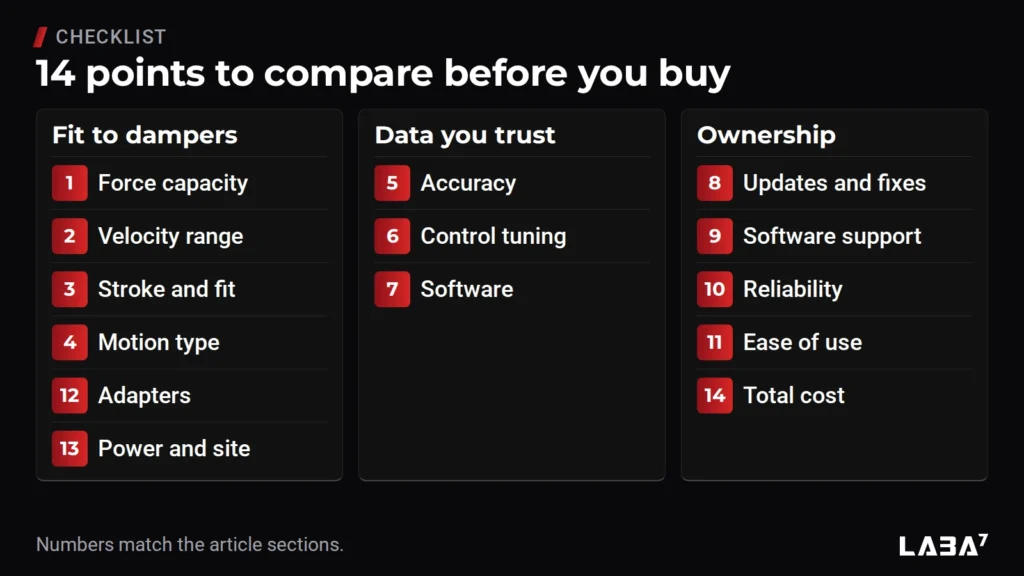
TL;DR: Start with force, velocity, stroke, motion type, adapters, and power&site comparison first. These criteria are your fundamentals. They will help you decide if machine is suitable for your use cases and which dampers you will be able to test at all.
Then compare measurement accuracy, control tuning, and software. They determine if the data you get can be trusted.
Lastly, check these items to make sure the machine will be easy to own: research how often company releases updates and fixes, check what people say about their reliability, ease of use, and technical support.
Before we start digging in deeper, here are some practical advices:
- Ask suppliers to give you the numbers you want to get, not the numbers on the brochure.
- If possible, test the machine before you buy. Don’t know where to test LABA7 damper testers? Get in touch with us, we will guide you to our customers that will not only show the equipment but also share their honest feedback.
Disclaimer: LABA7 builds shock dynos and EMA damper test systems. This checklist applies to any supplier, including us, and we state where our own products have limits just as openly as we share their specs and features.
Checklist
1. Force capacity
Check four things:
- Compression and rebound force limits.
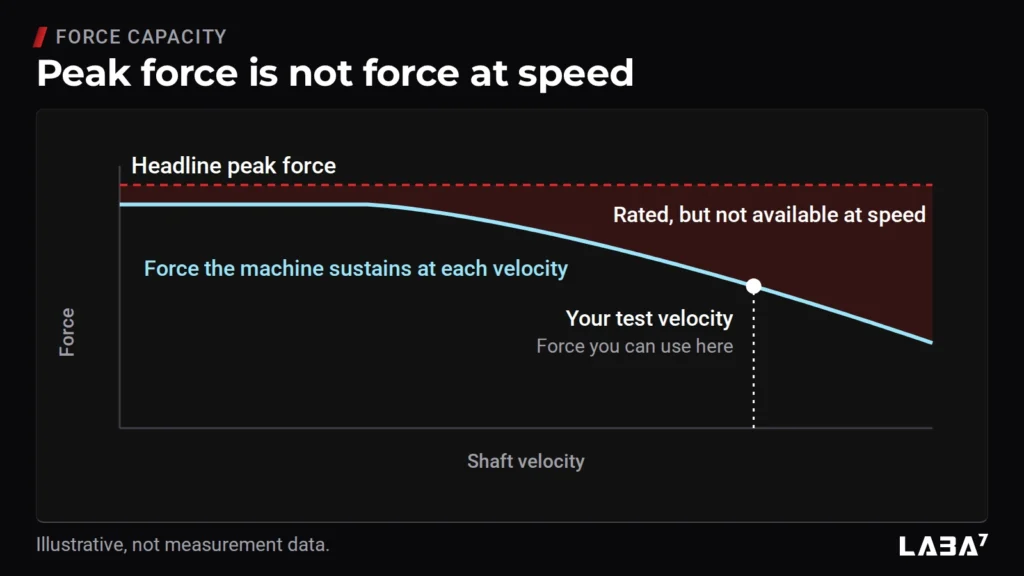
- The force the machine sustains at each velocity, not only the peak rating.
- The load cell range. A load cell sized for stiff dampers can lose resolution on soft ones.
- Do they come with overload protection?
The load cell should match the machine’s maximum force. Too small and it overloads. Too large and it loses resolution on soft dampers.
LABA7 sizes it to the machine: 10 kN on the Micro, Featherlight and Light shock dynos, 15 kN on the Mid and Heavy, and 20 kN on the Super Heavy. Smaller load cells are available on request for finer resolution. The Electrodynamic shock absorber testing machine EMA is built for higher forces, with peak force from 10 to 40 kN depending on the model.
2. Velocity range
Check the minimum and maximum velocity. The velocity under load is also great point to check but load is not constant you might get misleading number. Ask whether the stated figure is peak or average, and at which stroke.
Here’s some theory: low-speed capability can disclose seal friction, gas force and bleed behavior; whils t, high-speed capability shows blow-off and shim response.
Maximum velocity depends on the model and the stroke. LABA7 Scotch-Yoke shock dynos reach 1-1,000 mm/s (Micro), 5-1,900 mm/s (Featherlight), 5-2,600 mm/s (Light and Mid) and 8-3,000 mm/s (Heavy and Super Heavy). Speed rises with stroke, and the user manual publishes a speed-to-load table for each stroke.
The electromagnetic damper test system can achieve speed from 0.1 mm/s to 7,000 mm/s.
3. Stroke and mounting fit
Check three things:
- The available strokes.
- The maximum and minimum damper length that fits.
- The clearance for remote reservoirs and hoses.
Ask for the velocity limit at each stroke, because the two are often linked. LABA7 Scotch-Yoke strokes run from 10 to 150 mm, with free mounting length from 700 to 955 mm on the larger machines. See the full specifications for each model.
4. Motion type: sinusoidal or programmable
A Scotch-Yoke machine produces only sinusoidal motion: whatever velocity you set in compression, the rebound matches it. It is accurate, simple and low-maintenance.
An electromagnetic system runs triangle, square, pulse, sweep, chirp, pink noise, and track data, and can use different speeds in compression and rebound.
We compare the two in Electromagnetic vs Scotch-Yoke and types of shock testing machines.
5. Measurement accuracy
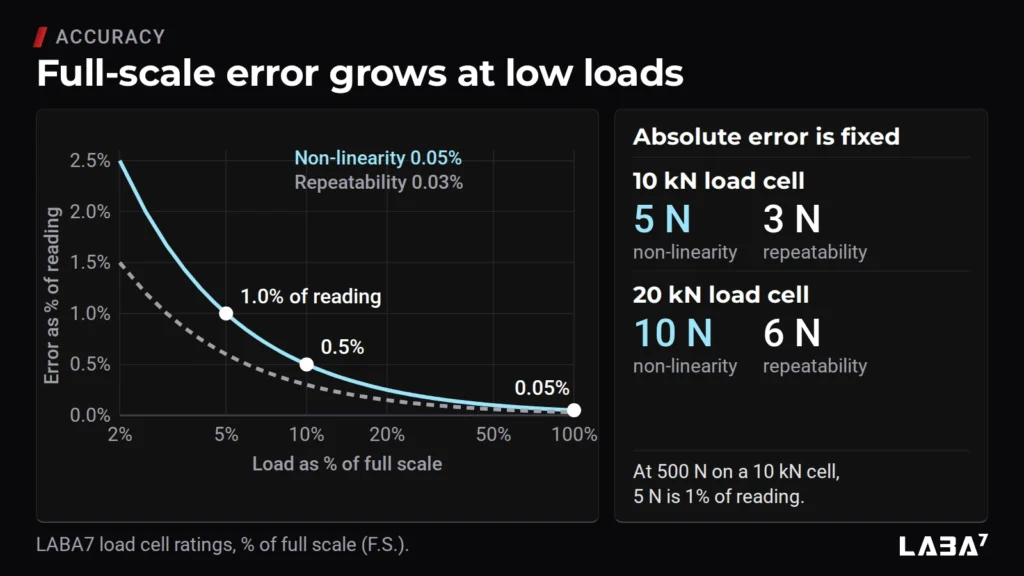
Ask for load cell non-linearity and repeatability as numbers. Ask whether each is stated as a percentage of full scale (F.S.) or of reading. With a full-scale rating the absolute error stays constant across the range, so the error relative to the reading grows as the load drops. Ask for the sampling rate and how much filtering the software applies. Less processing means the curve stays closer to the raw signal.
Here’are our numbers.
LABA7 load cells are rated at 0.05% F.S. non-linearity and 0.03% F.S. repeatability. On a 10 kN load cell that is 5 N and 3 N. On a 20 kN load cell it is 10 N and 6 N. At 5% of full scale, a 0.05% F.S. error is 1% of reading. If your dampers produce low forces, choose a smaller load cell: they are available on request. The in-house data logger samples thousands of times per second. The EMA logs at 20 kHz with 50 nm position resolution. Third-party calibration is available on request.
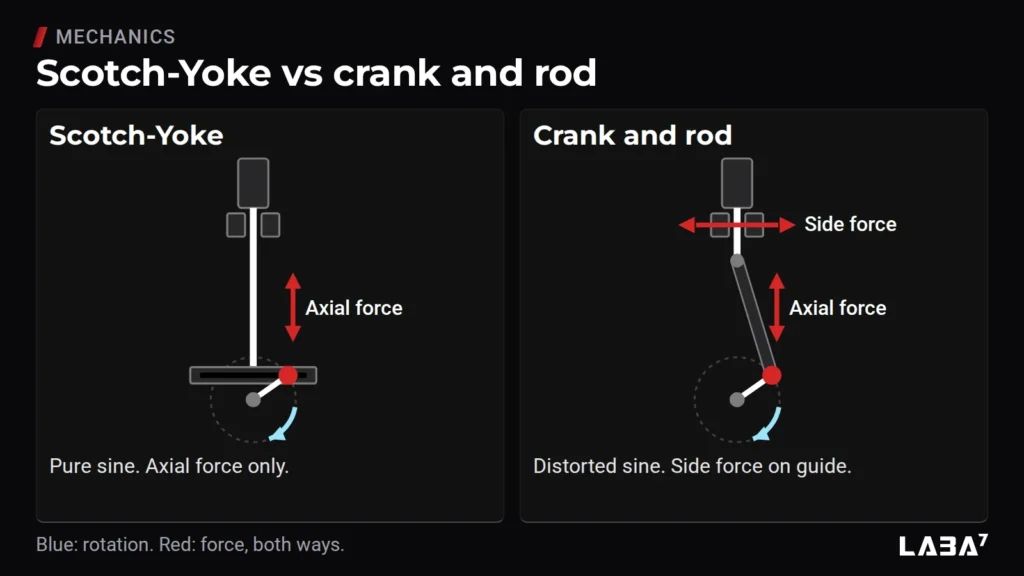
Mechanics matter too. In the ideal case, a Scotch-Yoke drive turns rotation into an ideal sine waveform, and its slot passes force along the damper axis only. A crank with a connecting rod produces only something similar to sine as it puts a side force on the guide.
Here’s a practical example: a customer who used a LABA7 dyno for about a year and a half wrote on Trustpilot that its low price made him doubtful, but “the performance data has proven to be accurate.” Even with Scotch-Yoke our machines are considered low price but accurate. So what is the point of sacrificing test results.
6. Control tuning
This part is more relevant for people considering EMAs or similar-grade equipment.
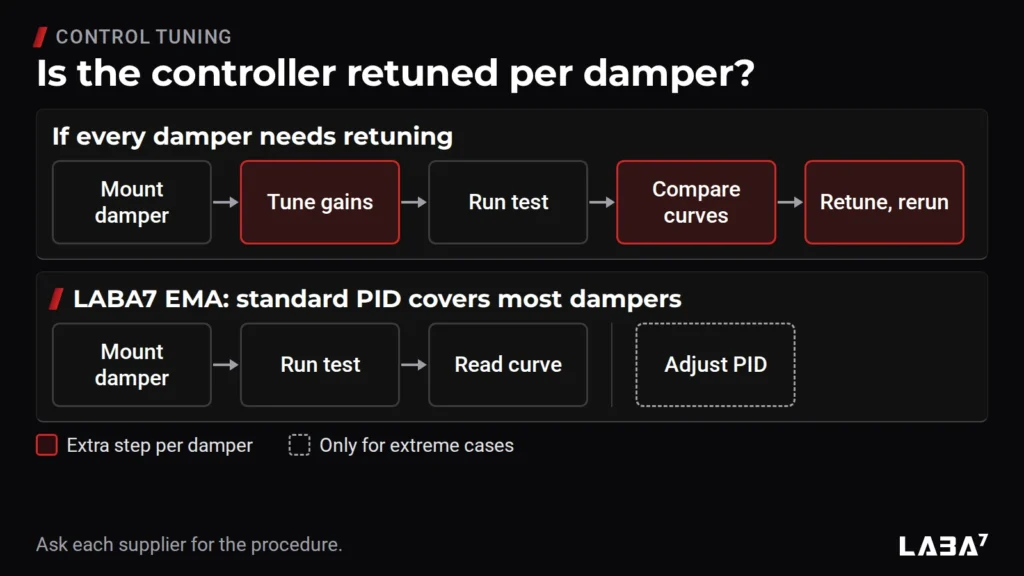
An electromagnetic actuator is steered by a feedback loop, usually PID (proportional-integral-derivative) control. A damper changes how that loop behaves, so some systems need the gains retuned for each damper. That takes time and operator skill.
Ask three things:
- Does the controller need retuning for each damper?
- Who does it, and how long does it take?
- Do two operators get the same curve from the same damper?
The LABA7 EMA has an accurate, wide-bandwidth control loop. With the standard PID settings, in our experience most of dampers test with no additional adjustment.
The PID is still adjustable, though. Very stiff dampers at low speed, and very light dampers at the maximum allowed speed, may need it. The adjustment is enabled in General settings, the procedure comes with the machine, and our support team can guide you through it.
7. Software
Ask what the software does, what it costs, and what it needs to run. Here’s what to look for:
- Graphs: force vs displacement, force vs velocity, force vs time, and velocity distribution are a mimimum.
- Run-to-run overlays, for left vs right or before vs after a change.
- Custom reports, unit conversion, and raw data export.
- Import of files from other systems.
- No dongle, no subscription, and a stated OS.
- Does it run on your own computer, or only on a bundled one?
LABA7 Shock Dyno Software is free with every machine, with no subscription and no fee for updates. It runs on Windows 8, 10 and 11 with no dongle. The machine is not tied to one computer.
It imports legacy Roehrig files, including files of most of our curent competition. It includes auto-stroke detection, self-calibration, collision detection, and mathematical gas pressure and spring force elimination. You can also run one-click PVP and velocity distribution tests.
8. Software updates and bug fixes
Check the release history. Ask how often the software is updated, how fixes reach customers, and whether updates cost extra. Old, unintuitive software that is rarely updated shows up as workarounds in daily use.
Since version 2.2.0, LABA7 software updates in the background, with an optional beta channel. Release notes are public. Version 2 needs the 6th-generation data logger, which is standard in units built after early 2023. Older machines need a logger upgrade, and support will confirm what your unit needs.
9. Software support
Support decides how long a fault stops your work. Ask five things:
- Who answers: an engineer who knows the machine, or a general helpdesk?
- How fast the first reply arrives.
- Whether faults are fixed remotely, including across time zones.
- Who helps install the software and train new operators.
- Whether independent reviews mention support.
LABA7 has a dedicated technical support team. Same-day response is the standard process, and most issues are resolved within 24 hours. Every customer gets 1-on-1 online onboarding. Support is remote, so distance does not change the process. Moreover, we store most of the spare parts at the headquarters, so in an unlikely event of component failure, substitute will dispatch within days.
Customers describe it in public reviews on Trustpilot and Google:
- Lukas Raus (Czech Republic): rated the process flawless, from communication to software installation and learning the machine with LABA7 technicians.
- André Martins (Portugal): “Their support reacts the same day.”
- Alexander Kreitmair (Germany): got an answer to every question within minutes.
- Intsales Technix (Japan): uses Featherlight daily, and singled out support during software updates and a bleeder fault.
10. Reliability
Ask three things:
- How long the oldest units have been in service.
- What typically fails.
- How fast the supplier repairs it and whether spares are held.
Read independent reviews, not only the supplier’s page. LABA7 has Trustpilot and Google reviews you can read in full.
- TBSUSPENSION (France): bought a suspension bench, added a spring tester two years later, and reported a very fast repair after a small fault at three years of use.
- Verpoorten Motorsport (Belgium): switched its equipment to LABA7 in 2023, including the EMA, spring dyno, shock dyno and filling machines.
- Beatriz Torres (US): “Dyno is heavy, solid. Works good.”
Maintenance is light. On the Scotch-Yoke shock dynos it is a yearly lubrication of two points, or sooner after intense use. On the EMA it is draining the air filter bottles when they are more than a third full.
11. Ease of use
A machine that is hard to run gets used less. Check:
- How long a new operator needs before the first test.
- How many setup steps a test needs.
- Whether the machine protects the damper from a bad installation.
Then watch operation videos from the supplier, and ask for a live demo where you set up the test yourself. LABA7 states that a full test cycle takes under two minutes from configuration to analysis. Auto-stroke detection and collision detection remove the two most common setup errors. See the step-by-step operating guide and how to test shock absorbers on a LABA7 dyno. A customer in the Czech Republic described the process as flawless from communication to learning the machine with LABA7’s technician.
12. Adapter
Adapters decide which dampers you can mount. List your mounting styles first: eyelet, clevis, rod-end, trunnion, strut, fork, or cartridge. Then check that the adapter exists, what it costs, and whether the supplier makes custom ones.
LABA7 makes adapters for AUTO, MOTO and MTB dampers, including self-preload clevis, rod-end, trunnion, MacPherson strut, fork and cartridge adapters. We also can manufacture custom adapers upon request.
13. Power and site requirements
Check the supply: 1-phase or 3-phase, the voltage, and the floor space and weight. This decides where the machine can go.
LABA7 MICRO, Featherlight and Light run on 1-phase power. MID, Heavy and Super Heavy need 3-phase. Machine weights run from 65 kg to about 430 kg.
The EMA runs on a standard 3-phase 380/400 VAC 16 A supply, and can be configured for 1-phase 220/240 VAC on request. Its supercapacitor bank delivers peak power during the test, so the grid draw stays low.
14. Total cost of ownership
The purchase price is one line. Ask for a written quote that includes:
- Software and updates.
- Adapters for your dampers.
- Onboarding.
- Calibration.
- Freight and installation.
- Spares.
LABA7 publishes machine prices on the product page. Software, updates and onboarding are included. LABA7 ships worldwide, including US freight. Adapters, calibration and freight are quoted per order.
Test before you buy
A smooth force-velocity curve is not proof of accuracy. Run the same checks on every candidate:
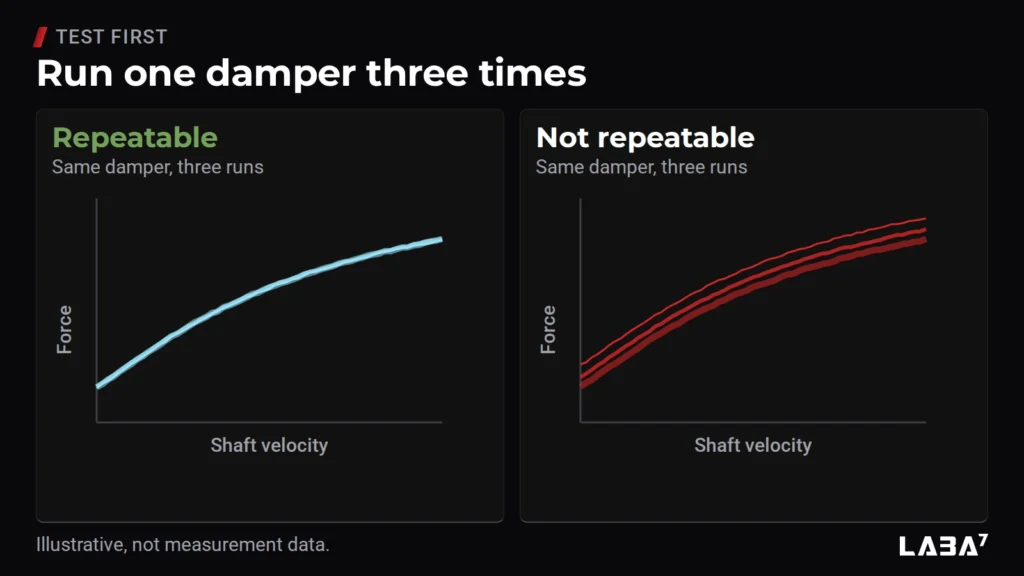
- Test the same damper three times without changing anything, and compare the curves.
- Test at a low, a medium and a high velocity.
- Change one adjuster click and see whether the machine resolves the difference.
- Repeat the test after the damper has warmed up.
- Export the raw data and check that force, displacement and velocity are synchronized.
- Ask for the calibration documentation.
What to ask every supplier
| Question | What a usable answer looks like |
|---|---|
| Force available at each velocity | A number per velocity, not only peak force |
| Velocity and stroke together | The velocity limit at each stroke |
| Load cell non-linearity and repeatability | Percentages, with full scale or reading stated |
| Sampling rate and filtering | Samples per second, and what is filtered |
| Control tuning per damper | A stated procedure, and how often it is needed |
| Software cost and update policy | Included, no subscription, release notes published |
| Software support | A named channel, a resolution time, remote help |
| Oldest units in service | Years, with what failed and how it was fixed |
| Adapters | Your mounting styles listed |
| Power supply | Phase, voltage, weight, footprint |
| Quote contents | Software, adapters, onboarding, calibration, freight |
FAQ
Is a higher maximum force always better?
No. A higher rating can mean lower resolution on soft dampers, and the force may not be available at your velocity. Check force at speed and the load cell range.
How accurate does a shock dyno need to be?
Accurate enough to resolve one adjuster click and repeat it. Ask for non-linearity and repeatability as percentages with the basis stated, then check repeatability yourself.
When do I need an electromagnetic system instead of a Scotch-Yoke machine?
When you need non-sinusoidal waveforms, track data playback, different compression and rebound speeds, or frequencies above what a crank mechanism delivers. Otherwise Scotch-Yoke covers sinusoidal testing at a lower cost. See types of shock testing machines.
What should I do if the software is old?
Ask for the release notes and the update policy. If updates stopped years ago, the machine will not follow new damper tests or operating systems.
Not sure which specifications match your dampers? Talk to our engineers.
Maybe you’ll find these interesting as well:
- What should I compare when buying a shock dyno: force, velocity, stroke, software and measurement accuracy?
- What a PVP Graph Hides?
- How to Read a Damper Test Rig Spec Sheet Without Being Misled?
- LABA7 Launches MICRO Shock Dyno for Trackside Testing
- LABA7 Introduces 5-Year Supercapacitor Warranty Policy