
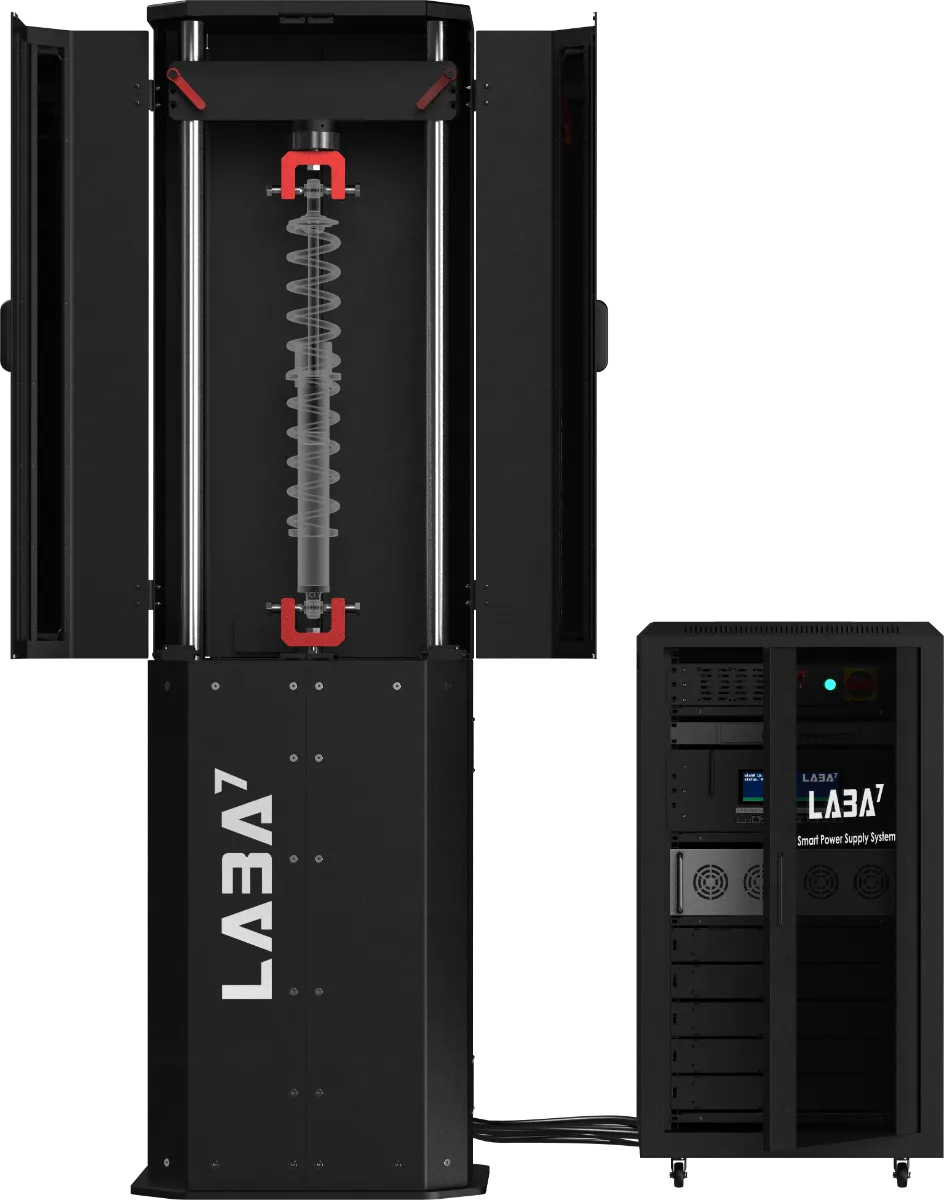
TL;DR: Scotch-Yoke is the workshop standard: reliable sinusoidal damper testing from €9,000, minimal maintenance, easy onboarding. EMA is the R&D-grade option from €65,000: programmable waveforms including real track data playback, 7 m/s velocity, 100 G acceleration, and far higher data resolution. Service and tuning workshops: Scotch-Yoke. Manufacturers, race teams, and labs doing advanced characterization: EMA.
Choosing between a Scotch-Yoke mechanism and an electromagnetic linear actuator has a real impact on what you can test and how precisely. Both technologies test dampers — the machines themselves differ in motion control, data depth, and price. (New to damper testing? Start with the shock dyno overview.)
Table of Contents:
- The Scotch-Yoke Dynamometer
- The Electromagnetic Dynamometer (EMA)
- Price Comparison
- Pros & Cons
- Head-to-Head Overview
- Which One Should You Choose?
The Scotch-Yoke Dynamometer

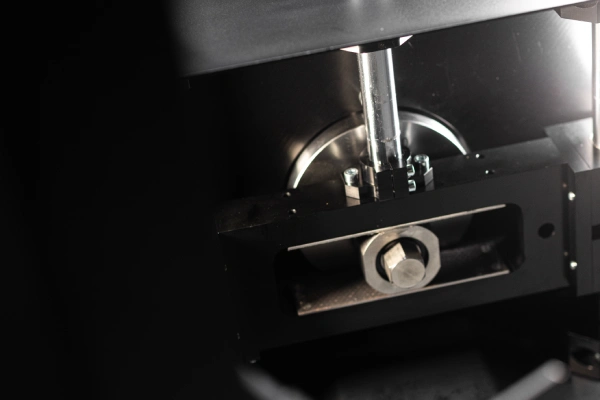
The Scotch-Yoke machine is the leading choice for workshops thanks to reliability, ease of use, and affordability. Its mechanism converts rotary motion into clean, consistent linear motion — simple mechanics, consistent feedback, minimal maintenance. LABA7’s lineup spans five models from the portable Featherlight (3 HP, 180 kg) to the Super Heavy (15 HP, 20 kN load cell), each with a proprietary data logger sampling thousands of times per second.
These machines test dampers across MTB, motorcycle, automotive, truck, and racing applications — the everyday tool for engineers, manufacturers, and mechanics servicing and tuning suspension.
Electromagnetic Dynamometer (EMA)
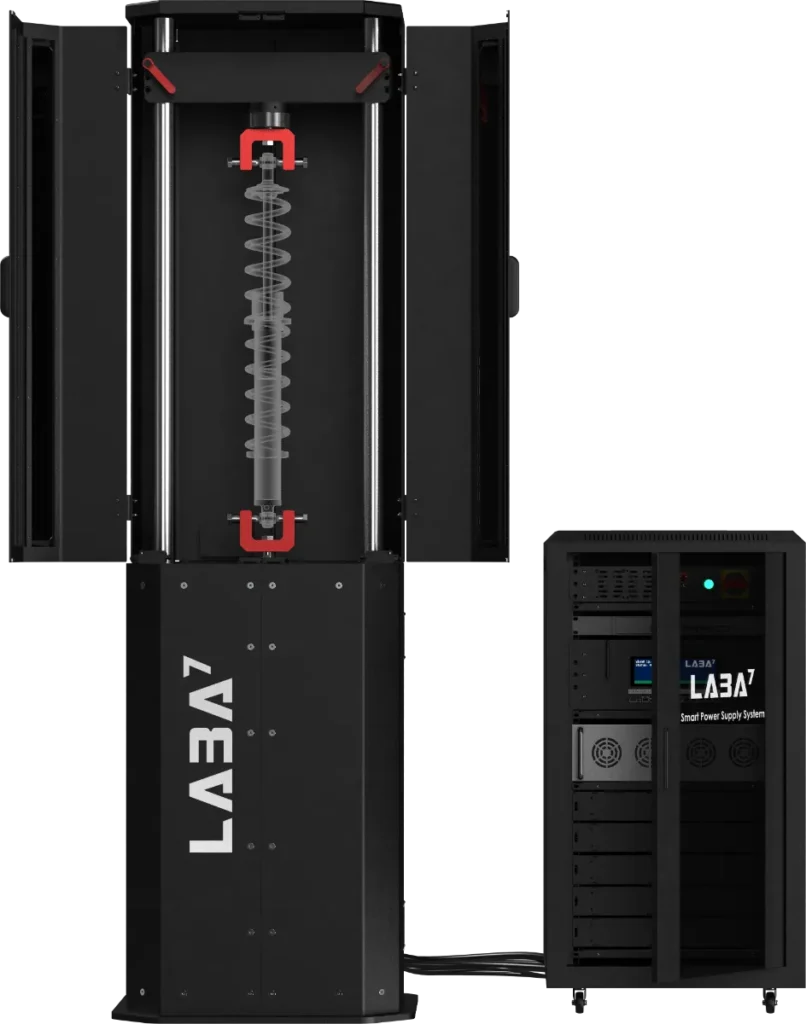
The Damper Test System EMA uses frictionless electromagnetic linear actuators for the most demanding testing scenarios. Four power levels — 30, 60, 90, and 120 kW — deliver peak force from 10 kN to 40 kN.
The in-house data logger provides 50-nanometer position resolution sampled at 20 kHz, with a synchronized 20-bit load cell also at 20 kHz — no phase shift between position and force data. Velocity spans 0.1 mm/s to 7 m/s, acceleration reaches 100 G, and test frequencies go up to 150 Hz. Beyond standard sine waves, EMA runs triangle, square, pulse, pink noise, sweep, chirp — and direct track data import, replaying any course against a specific damper.
The smart power supply unit makes this power accessible: supercapacitor packs deliver peak power to the actuators, so the standard connection is an ordinary 3-phase 380/400 VAC at just 16 A — and every model can be optimized for a standard 1-phase 220/240 VAC socket on request. The unit’s stored energy even completes a running test during a power outage, and it’s covered by a 5-year warranty.
This is such a big achievement that EMA Power Supply Unit Shortlisted for Innovation of the Year 2024.
Price Comparison
Scotch-Yoke models start at €9,000 (Featherlight) and top out at €28,000 (Super Heavy, 15 HP, 20 kN) ex VAT — current model-by-model pricing is on the product page.
EMA starts at €65,000 for the 30 kW model and reaches €176,000 for the 120 kW flagship ex VAT — full breakdown on the EMA page.
The gap is real, but so is the throughput difference: EMA tests faster, runs waveforms Scotch-Yoke physically cannot produce, and captures data at a resolution suited for development work rather than service verification. For a workshop, that capability is unnecessary; for a manufacturer, it pays for itself.
Pros & Cons
Scotch-Yoke
Pros: supports all common damper types with adapters; consistent, repeatable sinusoidal results; easy to learn and operate; in-house Shock Dyno Software included with 1-on-1 onboarding; from €9,000.
Cons: sinusoidal motion only — cannot replicate custom force profiles or road conditions; lower force ceiling and slower test throughput than EMA.
EMA
Pros: highest sampling rate and data resolution in the lineup; extreme force, velocity, and acceleration range; real-time damping force feedback; programmable and track-data waveforms; quiet operation (from ~60 dB — suitable for EV component testing); smart power supply with modest grid draw; in-house data logger, control unit, and software; 5-year power unit warranty.
Cons: significantly higher price; capabilities most service workshops won’t use.
Head-to-Head Overview
- Mechanism — EMA: electromagnetic linear actuation, full motion control. Scotch-Yoke: mechanical crank mechanism, fixed sinusoidal motion, valued for simplicity and robustness.
- Lineup — EMA: four models by actuator power (30–120 kW). Scotch-Yoke: five models by motor power and load capacity (3–15 HP, 10–20 kN).
- Data logging — EMA: 50 nm position resolution at 20 kHz, 20-bit load cell at 20 kHz. Scotch-Yoke: proprietary logger sampling thousands of times per second — ample for service and tuning work.
- Waveforms — EMA: sine, triangle, square, pulse, pink noise, sweep, chirp, track data import. Scotch-Yoke: sine only.
- Power input — EMA: 3-phase 16 A standard, 1-phase optional. Scotch-Yoke: 1-phase (smaller models) or 3-phase (larger models).
Which One Should You Choose?
Run a service or tuning workshop maintaining damper performance? A Scotch-Yoke machine covers your daily work at a fraction of the cost.
Developing suspension components, running a race program, or doing R&D that needs real-world force profiles and maximum data depth? EMA is the tool.
Unsure which fits your operation — talk to our engineers.
You also might like these articles:
- LABA7 Unveils New Specs for Electromagnetic Damper Test System
- HIL Testing and Electromagnetic Actuators in Suspension Testing
- LABA7 EMA vs Alternatives
- Choosing the Right Damper Testing Technology: EMA vs Scotch-Yoke
- LABA7 Introduces Novel Power Supply System for Electromagnetic Damper Test System
- EMA Power Supply Unit Shortlisted for Innovation of the Year 2024