
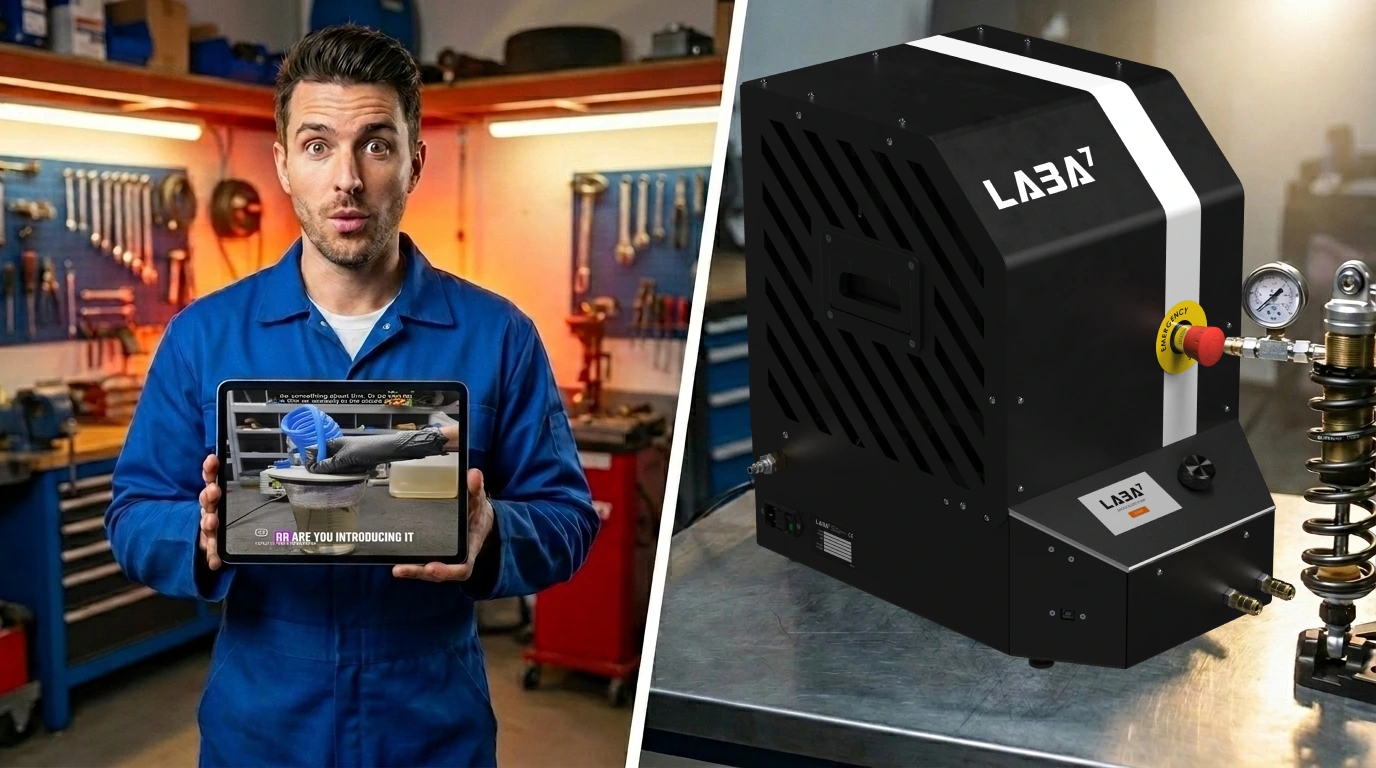
We recently came across a video by Filthy Motorsports on YouTube. In the video, it is said that shock oil straight from the jug doesn’t naturally contain air, and the viewer is led to believe that one doesn’t need a vacuum pump to prep your bulk oil before a service.
Here’s a surprise statement: Ben is not wrong! Well, entirely.
Some bits of the test conducted in the video might mislead people. The topic of bleeding shock absorbers is not just about air and oil. We already covered some of it in the article on how to bleed suspension dampers by hand vs using dedicated vacuum systems. So, in this post, we are going to try focusing solely on the specific claims made in the video:
- When Is Specialized Equipment Necessary?
- What the “Vacuum Bleeding Shock Oil to Remove Air“ Video Gets Right?
- The Flaw: Entrained Air vs. Dissolved Gases
- Why Deep Vacuum Cycles Matter Inside a Shock Absorber
- The Verdict: Are Dedicated Vacuum Systems Really Necessary?
When Is Specialized Equipment Necessary?
Here’s the truth.
Suspension professionals and even amateurs can do “good enough” bleeding by hand. We will go even further and say something controversial:
They can even do the “just as good” bleeding. For certain applications.
For commuting, easy rides, weekend escapades, bleeding by hand and bleeding with a designated machine will provide similar results. Only the pickiest and most attentive riders might feel the difference. The only real problems are that bleeding by hand has quite a few moments for “human error” and requires more time. Especially if you rely on the atmosphere to degas your oil.
But when we’re talking about racing, training, hard rides, the talk is different. With the temperature of the shock rising, the effects of gasses left in the damping system become exponentially more intense. Fade and the loss of damping they bring become a real liability.
Two more things to have in mind:
- Professional equipment remove gasses not only from oil but from the damper itself.
- Another area where these machines stand out – consistency. They deliver consistently perfect bleeding, often 2 times as fast and without a mess. Plug it, set the program, wait a few minutes.
So, when vacuum-treating oil is not necessary:
- You work on your own shocks and you know them in&out – you changed oil a million times and know the angles of removing all air bubbles.
- You have spare time for a perfect bleed.
- You will not be pushing your suspensions hard.
On the other hand, when professional equipment is necessary:
- Damping systems will see high-performance use.
- You run a professional workshop where time is money. Our automatic models do the same job about two times faster and you don’t have to be present – you can do whatever you want.
- You care about your reputation and “good enough” is not on the menu. Every single shock that leaves your workbench must meet your quality standards. Every. Single. Time.
- You work with complex modern shocks that have blind cavities, intricate clicker circuits, and microscopic spaces.
What the “Vacuum Bleeding Shock Oil to Remove Air“ Video Gets Right?
Let’s get back to the video and give credit where it’s due: Ben runs a great visual demonstration.
He proves that if you pour shock oil turbulently, you introduce visible air bubbles into the liquid. If you pour it slowly (or just let it sit on a workbench for 20 minutes), those bubbles rise to the top and vanish.
His conclusion is that you don’t need a vacuum pump just to prep a jug of oil.
We just want to be extra clear that the conclusion is not implied. Ben opens the video by calling out the myth that ‘you have to vacuum pump every gallon… prior to service.’ After his 20-minute test, his final verdict: the tiny amount of remaining air ‘is not enough to have been an issue… so all you can do is just let it sit.’
Our own testing here falls perfectly in line with what he shows. If someone told you that shock oil sitting in a bottle is inherently “full of air” and must be vacuum-pumped before you can even pour it, they are overcomplicating things. For getting visible air out of bulk oil, simple patience and gravity work perfectly fine.
The Flaw: Entrained Air vs. Dissolved Gases
Before you continue reading, note that in no way, shape, or form do we doubt Ben’s competence, skills, or overall expertise.
Just in the context of this basic test, he did not cover the complex physics of dissolved gases and how oil behaves inside an actual shock very well. Probably because he wanted to ensure the video is not only educational but entertaining as well. Just as we do whilst making our videos.
So, where the video’s logic falls short is that it only addresses visible air in an open cup. There are two types of air in suspension fluid:
- Entrained Air. It’s basically the visible bubbles trapped during clumsy pouring (what Ben shows).
- Dissolved Gases. Air and moisture absorbed into the fluid at a molecular level. You cannot see this with the naked eye.
When Ben applies his vacuum pump to the carefully poured oil and “nothing happens,” it isn’t because the oil is perfectly free of air. It is because his simple chamber test might not be pulling a deep enough vacuum to break the vapor pressure threshold of the fluid.
Our shock bleeders (even the MANUAL one) pull up to a massive vacuum of -0.99 BAR (evacuating about 98% of the atmosphere). At this extremely low pressure, the physics of the oil completely change. If you put a fresh, bubble-free cup of shock oil under a -0.99 BAR vacuum, it will suddenly begin to “boil” and foam up at room temperature. This is the invisible dissolved air and microscopic moisture being violently ripped out of the fluid.
Remember: after this procedure, air-free oil is injected with force into the air-free damper, concluding a perfect bleed.
Why Deep Vacuum Cycles Matter Inside a Shock Absorber?
Another area where video fails to explain to the viewer the intricacies of shock bleeding is that during the test, shock oil sitting in an open cup is shown as the final metric of success.
But in the business of suspension servicing, damper oil doesn’t stay in a cup; at the end of the day, it goes inside a highly complex, sealed mechanical system.
Now, the following explanation will get a little technical, but please bear with us. We tried to simplify it as much as possible without losing critical information:
- When a damping system works hard over rough terrain, the fluid is forced through tiny piston shims at massive velocities.
- This creates severe, localized pressure drops.
- If there is dissolved air or a trace of moisture still living inside the oil (which bleeding by hand and resting cannot remove), those extreme pressure drops cause the invisible gases to instantly flash-boil into bubbles.
- This is called cavitation, and it results in immediate shock fade and loss of damping control.
Furthermore, a modern bypass shock or twin-tube design is filled with microscopic “blind cavities” within the clicker circuits. When you manually pour oil into a shock, air gets permanently trapped in these labyrinth-like crevices.
The Verdict: Are Dedicated Vacuum Systems Really Necessary?
Are machines for damper maintenance necessary to prep a jug of oil on your workbench? No. The video is completely correct that careful pouring and a little patience will resolve your bulk oil issues.
Is professional equipment necessary to build a fade-free, race-ready suspension system? Absolutely.
A simple vacuum chamber might prove that pouring causes bubbles, but it takes a professional-grade deep vacuum and pressure cycling to remove the invisible dissolved gases and moisture that actually cause a shock to fail on the track. To see the machine process step by step, read how to use a vacuum bleed pump.