
Updated October 2026
TL;DR: A Scotch-Yoke dynamometer is the affordable, robust choice for workshops. It tests dampers with sinusoidal motion and generally is accurate, simple, low-maintenance. An electromagnetic (electrodynamic) shock absorber testing machine EMA costs more but adds programmable motion profiles, wider speed and displacement range. It also delivers higher precision for R&D work. Most service workshops are fully covered by Scotch-Yoke; race teams and manufacturers doing advanced characterization should look at EMA.
There are several types of damper testing machines in the market: Crank-driven, Scotch-Yoke, Hydraulic, and Electromagnetic.
- Crank-driven testers are cheap but their data samples typically require more digital filtering that translates into less detailed test results, that might hides small changes in damper behavior.
- The Scotch-Yoke shock dyno solves this: it produces clean sinusoidal motion, so the data needs far less filtering and reveals even minor performance changes — while staying affordable.
- Hydraulic systems can reach higher forces than the current EMA models, whose peak is 40 kN at 2 m/s. They use pressurized fluid and a hydraulic power unit. The EMA is all-electric.
- Electromagnetic systems match their power and testing capabilities while being quiet, efficient, and more affordable to run.
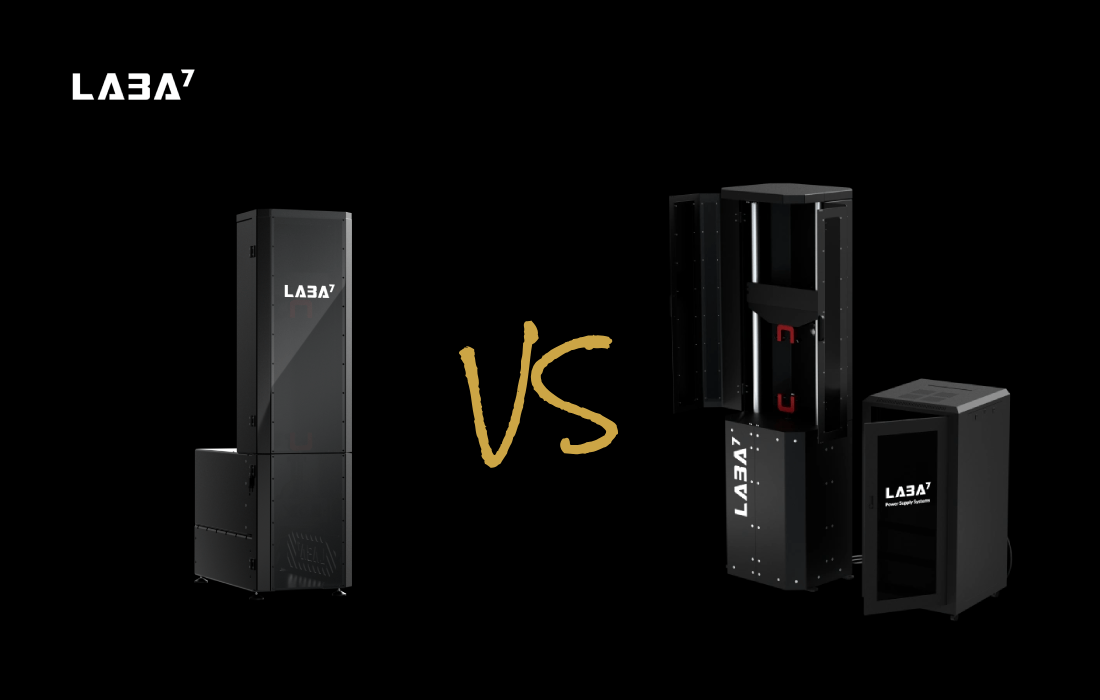
At LABA7 we build two types of damper tester: electromagnetic (EMA) and Scotch-Yoke. They provide excellent accuracy, durability, and value for money.
But how are they different?
- EMA vs Scotch-Yoke at LABA7
- Precision and Control Flexibility
- Speed and Range
- Maintenance
- Power Requirements
- Installation
- Calibration
- Software
- Training and Support
- Warranty
EMA vs Scotch-Yoke at LABA7
The Damper Test System EMA and the Scotch-Yoke machines both test shock absorbers, but they differ significantly in mechanism and performance.
EMA offers greater precision, control flexibility, and overall capability, making it suitable for the widest range of testing scenarios — at higher cost and complexity. Scotch-Yoke machines are simpler, more robust, and cheaper, with limits in motion control and versatility. The right choice depends on your testing requirements and budget.
Precision and Control Flexibility
- EMA offers high precision and control over movement, allowing real-life conditions to be replicated in a test environment. The use of an electromagnetic linear actuator and feedback systems enables precise control of velocity, displacement, and force. EMAs can be programmed to simulate a wide variety of motion profiles, including non-sinusoidal waveforms, making them more versatile for different types of shock absorber testing. Why the waveform matters when comparing rigs is covered in how to read a damper test rig spec sheet.
- Scotch-Yoke provides only a sinusoidal motion that may not be as easily controlled or adjustable.
Speed and Range
- EMA covers a wide range of speeds and displacements, from very slow to very fast movements, and is typically much more powerful.
- Scotch-Yoke: The speed and force are typically more limited and fixed by the mechanical design.
Maintenance
- EMA has fewer mechanical wear points, so less maintenance over time. If compressed air is connected, drain the filter bottles when they are more than one third full.
- Scotch-Yoke: lubricate two points (rod bearings and slider plate) once a year, after intense use, or when the grease looks worn.
Power Requirements
- EMA: Standard requirement is 3-phase 380/400 VAC, 16 A on all models. It can be optimized for 1-phase 220/240 VAC or the 110/120 VAC US grid on request. Supercapacitors store energy for peak actuator demand, and the stored energy can be enough to finish a running test if mains power drops out.
- Scotch-Yoke machines draw power directly from the grid: smaller models run on 1-phase 220/240 VAC (110 VAC on request), larger models require 3-phase 380/400 VAC.
Instalation
- EMA: installed, commissioned and configured in cooperation with LABA7, remotely in the US and overseas. The customer unloads the machine, anchors it to the floor with bolts, and connects mains power, ground and a compressed air supply. Poor anchoring can cause vibration and inaccurate results. Installation verification, a first test run and operator training must be completed before independent operation.
- Scotch-Yoke: place it on a flat, level surface, connect the power cable and install the software. LABA7 support helps with installation on request.
Calibration
Both machines are tested and calibrated in-house. Independent calibration is available on request for both machines. In the software, a calibration run after damper installation measures adjusted stroke, rod force, gas force and shock temperature, and the load cell can be tared.
Software
Both machines run the same LABA7 Shock Dyno Software v2 on Windows 8, 10 or 11. It plots force vs velocity (including force vs peak velocity and force vs average velocity) and force vs displacement, from logged force, displacement, velocity, current, temperature and acceleration channels. To log extra sensors alongside these channels, add the data acquisition system for shock dynos. What the peak-velocity plot leaves out is covered in what a PVP graph hides.
It is free, the full license comes with every test bench, and it needs no dongle or subscription. Standard updates are free as well. From version 2.2.0 it updates in the background, with an optional beta channel.
- The EMA adds waveforms beyond sine: Sine, Sine-on-Sine, Constant velocity, Constant acceleration, Sawtooth, Inverted sawtooth, Impulse, Free fall, Pink noise, Linear sweep, Exponential sweep, Linear chirp, Exponential chirp, and Direct track data import.
- Scotch-Yoke: runs sine waves only.
Training and support
Both include one-on-one online onboarding and customer support by email and WhatsApp.
Warranty
- EMA: 1-year manufacturer warranty, plus a 5-year warranty from commissioning on the power supply unit (supercapacitor bus).
- Scotch-Yoke: 1-year manufacturer warranty from the date of purchase.